
The 5 Best Mesh Wi-Fi Systems for Large Homes (2026)
Slow Wi-Fi Doesn't Always Mean You Need a New Internet Plan
One of the most common complaints we hear is:
"My internet is fast in the living room, but terrible in the bedrooms."
In many cases, the problem isn't your internet provider, it's your home's Wi-Fi coverage.
As installers, we've found that many homeowners upgrade to faster internet packages when what they really need is better wireless coverage. If your router is tucked into a basement corner or hidden inside a cabinet, even gigabit internet won't solve dead zones throughout the house.
For many homes, a quality mesh Wi-Fi system is an excellent solution. However, larger homes or homes with heavy smart-home usage may benefit from professionally designed wireless access points instead.
In this guide, we'll explain which mesh systems stand out, who they're best for, and when it may be time to consider a more advanced solution.
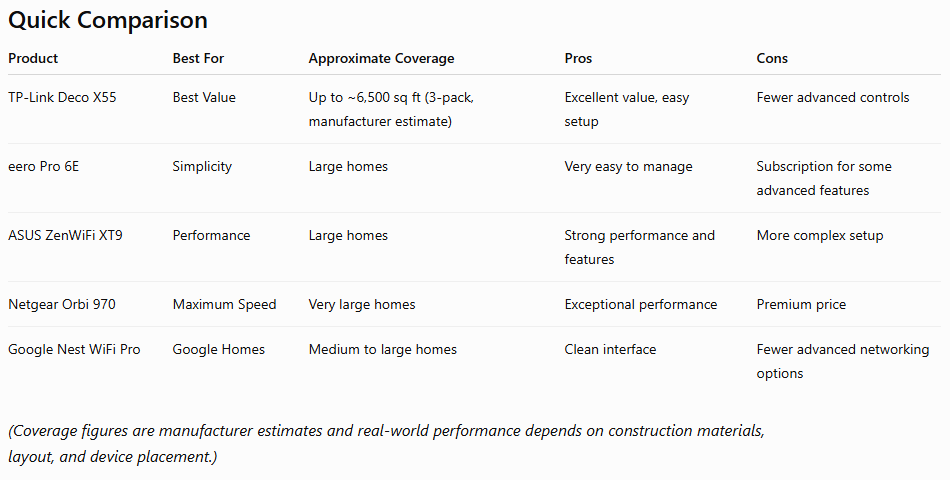
1. TP-Link Deco X55
Best Overall Value
If you're looking for an affordable system that performs well for most households, the Deco X55 is difficult to beat.
Pros
Straightforward installation
Reliable performance
Good value
Excellent app
Considerations
Limited advanced networking features
Power users may want more customization
Best For
Homes under approximately 4,500 sq ft
Families with streaming, gaming, and smart-home devices
Amazon Link
2. eero Pro 6E
Easiest to Use
Amazon's eero ecosystem is known for its simplicity. If you want to set it up once and largely forget about it, this is a strong choice.
Pros
Excellent mobile app
Automatic updates
Easy expansion
Considerations
Some advanced features require an optional subscription
Less flexibility than enterprise networking gear
Amazon Link
3. ASUS ZenWiFi XT9
Best for Power Users
The XT9 offers more control over your network while still providing the convenience of a mesh system.
Pros
Fast performance
More advanced configuration options
Strong parental controls
Considerations
Slightly steeper learning curve
Amazon Link
4. Netgear Orbi 970
Premium Performance
If you have a very large home with dozens of connected devices and want top-tier performance, Orbi is worth considering.
Pros
Outstanding speed
Dedicated wireless backhaul
Excellent coverage
Considerations
High upfront cost
Amazon Link
5. Google Nest WiFi Pro
Best for Google Smart Homes
If your home already uses Google Assistant, Nest speakers, or Google Home products, this system integrates naturally.
Pros
Easy setup
Clean interface
Attractive hardware
Considerations
Fewer advanced networking features
Amazon Link
When Mesh Isn't the Right Solution
Mesh Wi-Fi works well for many homes, but it's not always the best answer.
If your home is:
Over approximately 4,500–5,000 sq ft
Built with concrete, stone, or metal construction
Undergoing new construction or a major renovation
Running dozens of smart-home devices
Supporting home offices, gaming, or media servers
then a professionally designed wired access point system often delivers more consistent performance.
Why We Frequently Recommend Ubiquiti
For larger homes and businesses, we often recommend Ubiquiti UniFi systems because they offer:
Wired access points
Centralized management
Better roaming between access points
Enterprise-grade reliability
Easy expansion as needs grow
Rather than relying on wireless communication between nodes, wired access points provide a more stable foundation—especially in larger or more complex environments.
Not Sure Which Is Right for Your Home?
Every home is different.
Wall materials, layout, internet speed, and the number of connected devices all affect wireless performance.
If you're unsure whether a mesh system or wired access points make more sense, High Ground Solutions can help you evaluate your home and recommend the right solution.
Schedule a Consultation